ON VIEW NOW
Michael Zheng
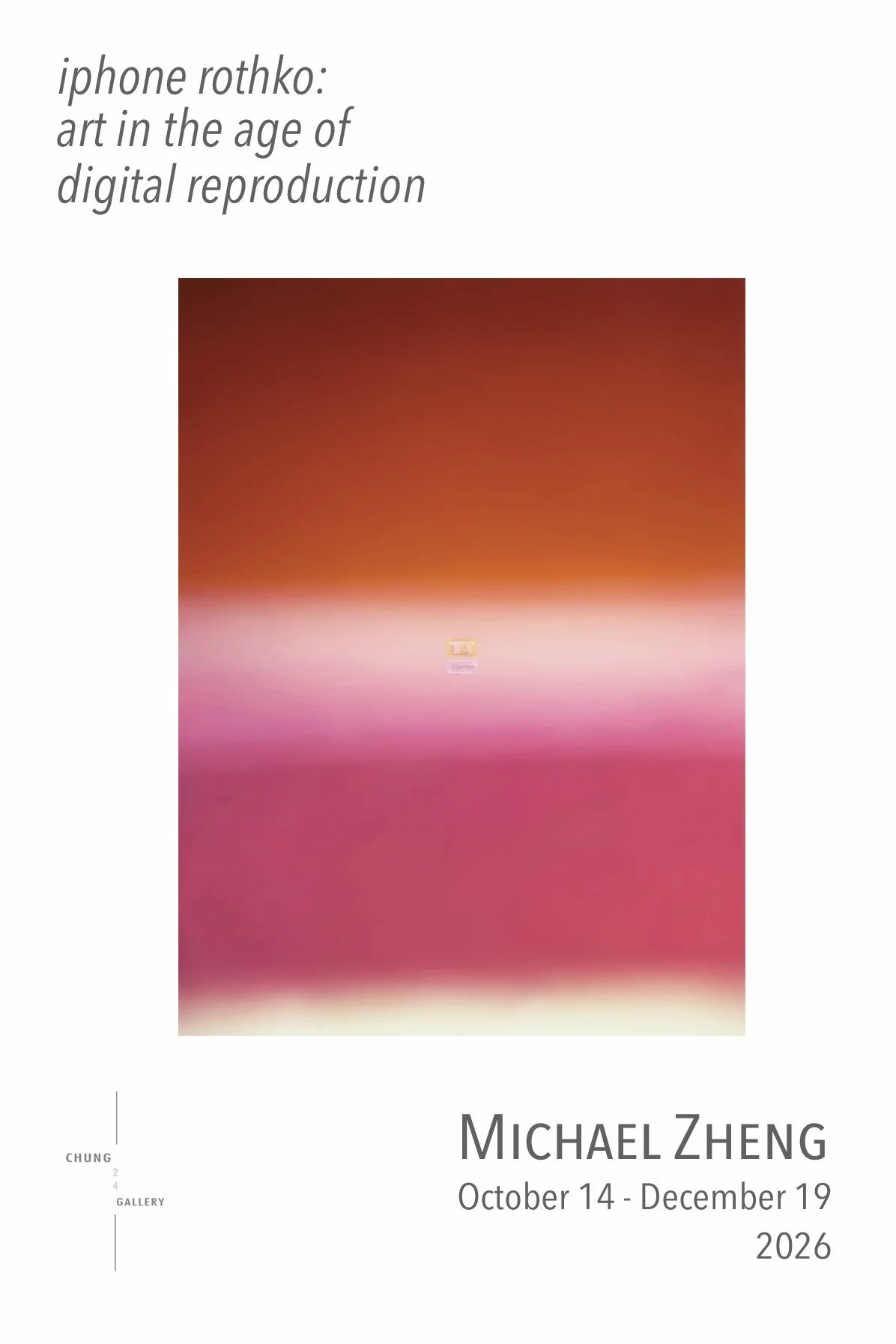
iphone rothko: art in the age of digital reproduction
october 14 - december 19, 2026
ARTIST WALKTHROUGH + RECEPTION
Saturday . OCT 24, 2026
2 - 5pm
ARTIST WALKTHROUGH + RECEPTION Saturday . OCT 24, 2026 2 - 5pm
Artist Statement
iphone rothko: art in the age of digital reproduction
The work in the show explores how intentional or unconscious mediation influences our perception of the world.
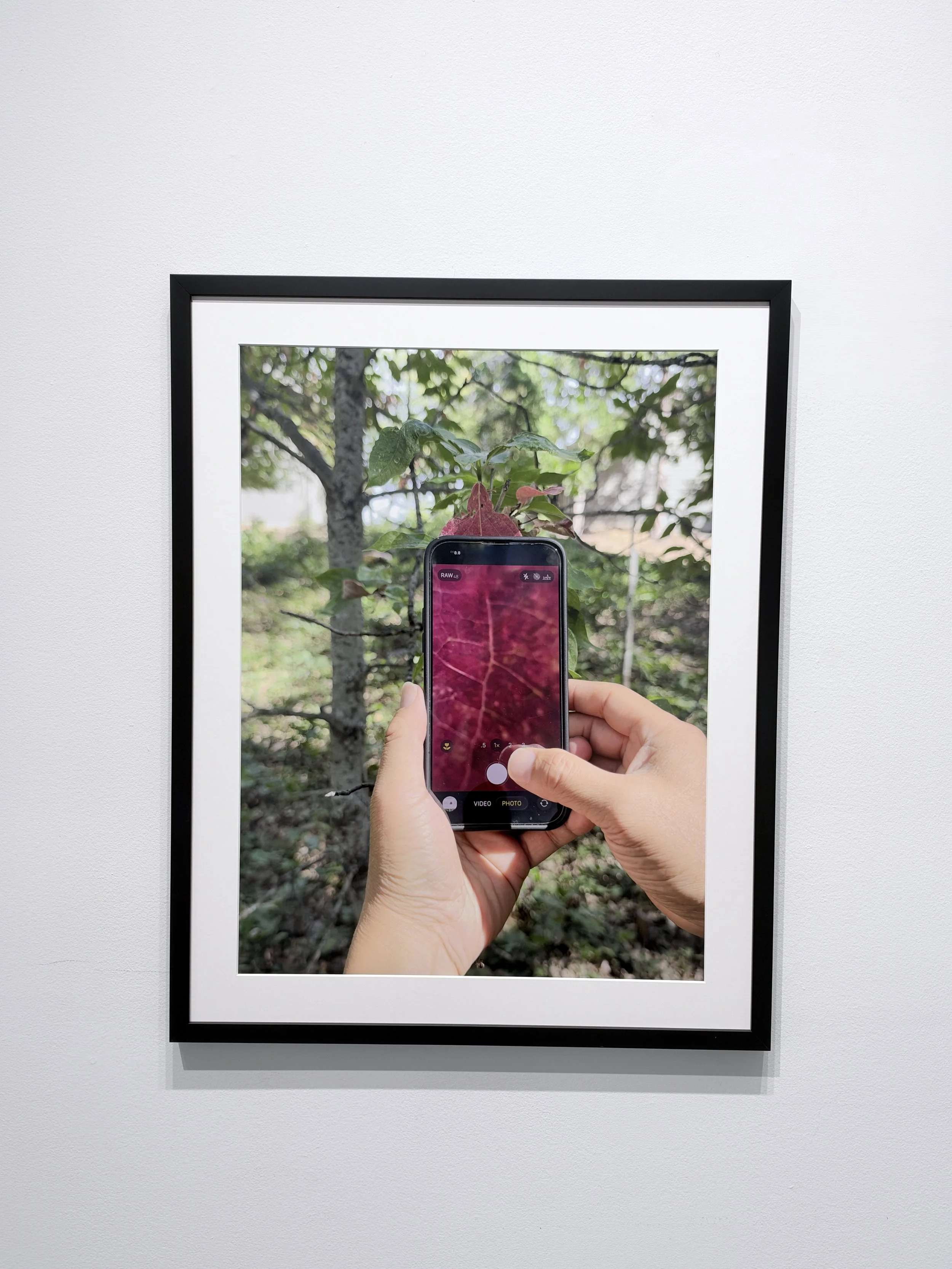
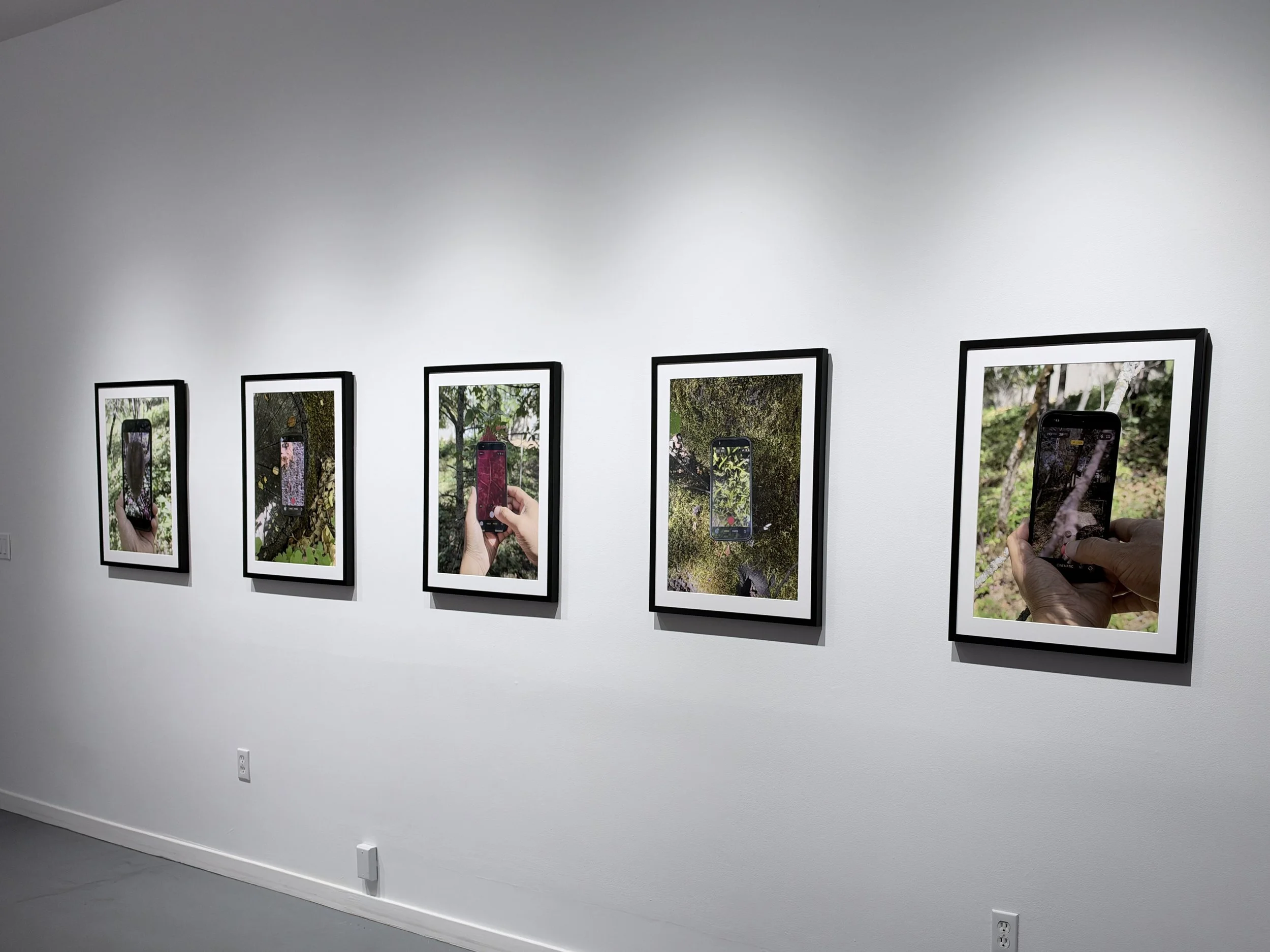
In the first series, iPhone in Nature, an iPhone carefully frames a part of nature, something we all do these days. But that act itself is in turn captured in the photographs, along with the surrounding nature that the act tries to frame. The effect is simultaneously attractive and slightly alarming. The image on the iPhone screen seems to alter whatever surrounds it, making it look suddenly alien and enticing. At the same time, it engenders a sense of disbelief that such a jarring difference could be effected simply by positioning the iPhone in a particular way.
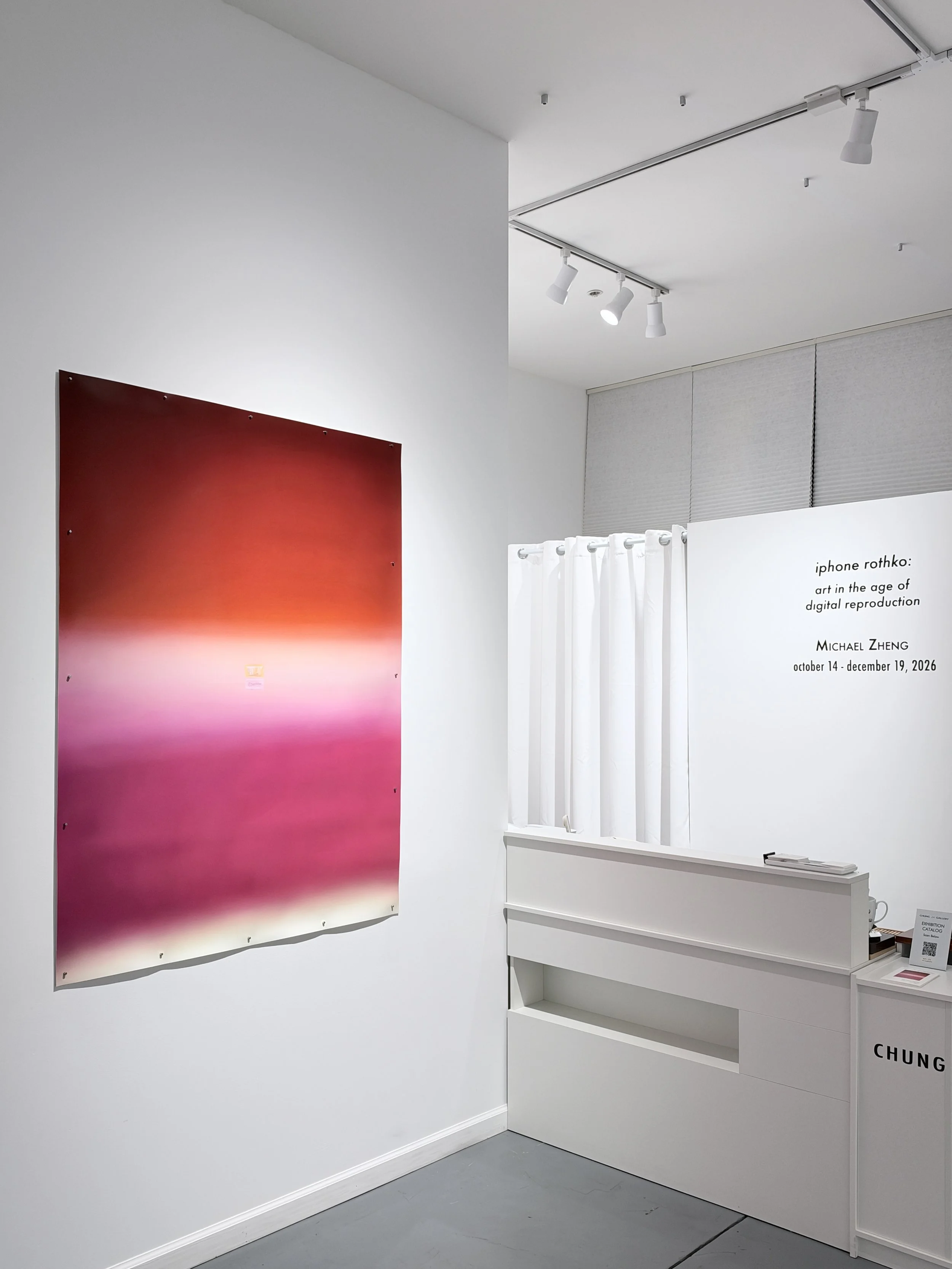
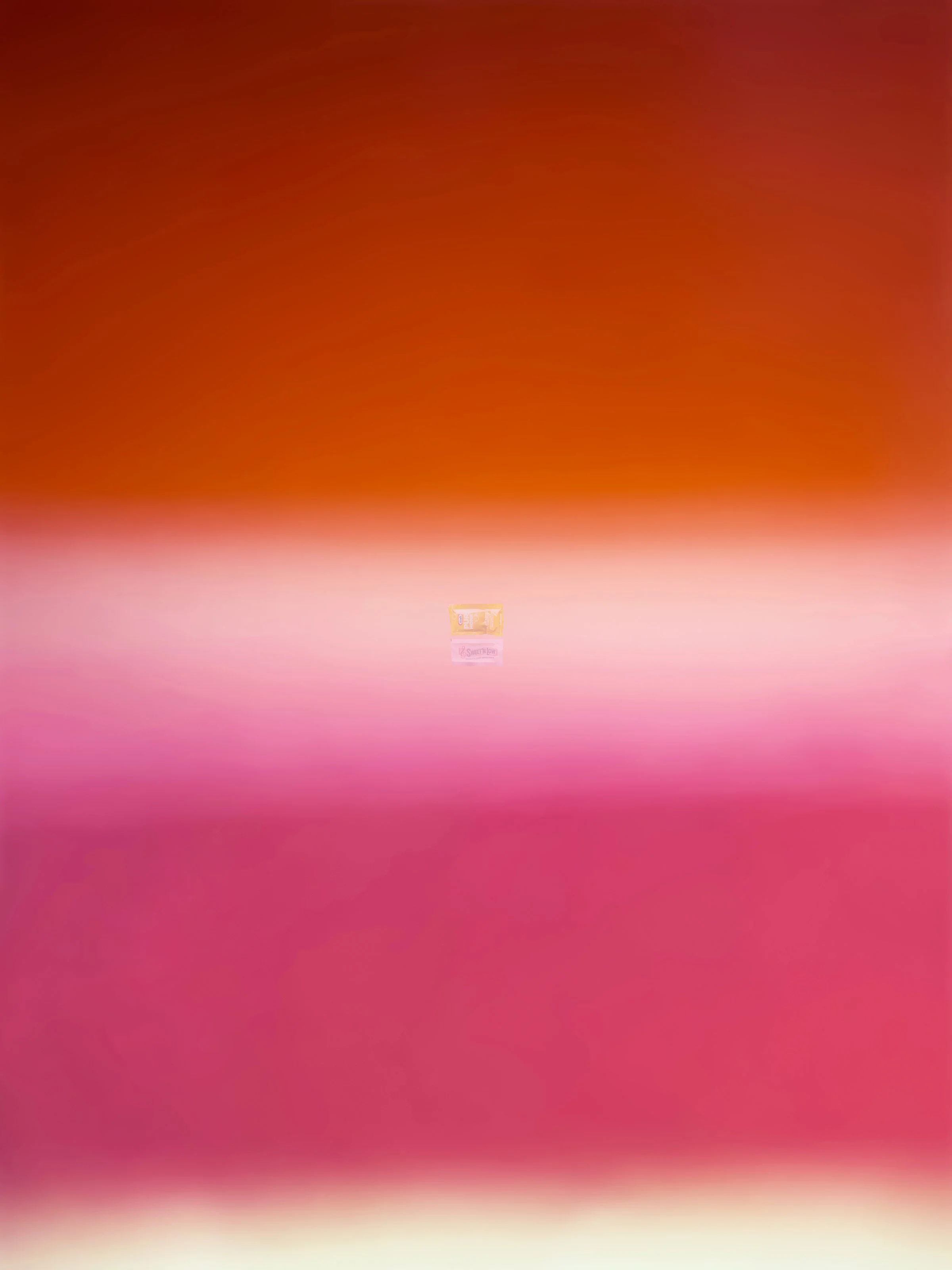
In the second series, iphone rothko, the power of digital reproduction rudely blurs the boundary between the sacred and the profane in one swoop. Position an iPhone close against a reproduction of Duchamp’s famous Nude Descending a Staircase, and, rather mysteriously, a Rothko-like image appears. Place it instead against two bags of tabletop condiments—“pure honey” and “Sweet’N Low”—and, again, Rothko seems to materialize. A Duchamp becomes a Rothko; honey and artificial sweetener become abstract images. At this point, almost anything will do. - Michael Zheng
Michael Zheng: iphone rothko: art in the age of digital reproduction
by Terri Cohn
What happens when we look at nature through a screen? And what happens when we begin to look at the screen itself as part of nature?
Michael Zheng’s iphone rothko begins with an act that has become almost invisible through repetition: holding up an iPhone to photograph the world. In iPhone in Nature, however, Zheng makes the familiar gesture itself the subject of the photograph. We see the phone held up to the landscape, with an image of nature appearing on its screen while the physical landscape remains visible around it. The photograph contains both the world and its digital representation, making visible the mediation that ordinarily disappears from view.
Zheng extends a history of artists who have used photography to transform our relationship to nature. Alfred Stieglitz’s Equivalents, his photographs of clouds made in the 1920s and ’30s, turned external observation into images of internal states. Andy Goldsworthy likewise uses photography to extend encounters with ephemeral works that change and disappear. Zheng brings this history into the digital present, where the iPhone is not simply a camera but a screen and an instrument through which experience is filtered.
In iphone rothko, placing an iPhone against a reproduction of Marcel Duchamp’s Nude Descending a Staircase produces a Rothko-like abstraction. Positioned against packages of “pure honey” and Sweet’N Low, the same phenomenon occurs: the ordinary becomes abstract, and almost anything can suddenly resemble a Rothko. The distinctions between original and reproduction, high art and everyday commodity, begin to dissolve.
The title invokes Walter Benjamin’s The Work of Art in the Age of Mechanical Reproduction and its question of what happens to an artwork’s aura when images can be endlessly reproduced. But Zheng seems less interested in the disappearance of aura than in its transformation. Meaning proliferates: an image becomes another image, and the boundaries between art and the world around it become unstable.
There is an irony here. Mark Rothko sought an immersive, almost spiritual encounter with painting. Zheng inserts the iPhone between viewer and artwork, replacing direct encounter with technological mediation. Yet this interruption becomes a form of attention. Zheng’s practice, rooted in Ch’an Buddhism, is concerned with mindfulness, presence, and the instability of appearance and reality. By making the smartphone—the device we constantly look through without thinking—the subject of his photographs, he interrupts that automatic act of seeing.
It was only while writing about this process that I recognized an unexpected parallel with my own. I chose to write this essay, in part, through a mediated exchange with an AI: offering my observations, receiving them back in another form, questioning and revising what I encountered. I would not ordinarily make my writing process part of an art review, but here the connection seems relevant. Zheng makes us conscious of the technologies through which we see; in writing about his work, I was reminded of the technology through which we are now able to think and write. What began as a means of working on the essay became, unexpectedly, another form of collaboration with Zheng’s work.
The experience has also prompted a question about whether this process resonates with the mindfulness at the center of Zheng’s Ch’an Buddhist practice—not because the process itself is Buddhist, but because mediation can become a means of paying closer attention to how we perceive.
Zheng asks us to look at the world, and then to look again at how we are looking at it.
The Artist
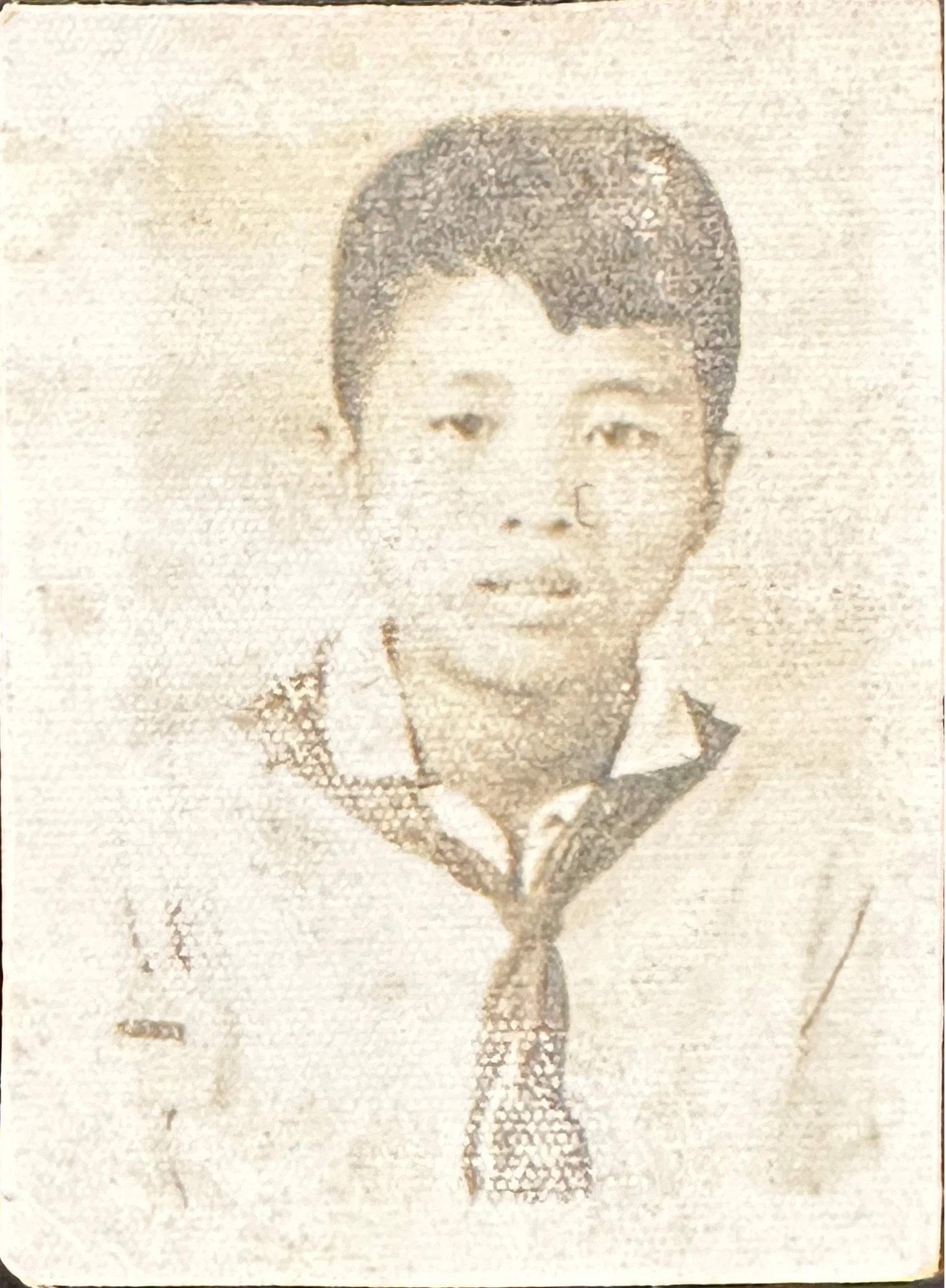
Engineer-turned-conceptual-artist Michael Zheng was born in China and is currently based in California. His art is primarily focused on cultivating the viewer's awareness of their own perceptual process.
His practice of Zen Buddhism has a profound influence on his art. By skillfully reconstituting the formal and cultural elements of a given situation, his work illuminates the poetic and transcendent moments inherent in daily life. Conceptual in nature, his work often takes the form of performance, site-specific installation, and drawings.
Michael has exhibited his work worldwide, including in the Baltic Triennial at the ICA/London, Vancouver Biennale, Portland Museum of Art Biennial/USA, Art Gallery of Greater Victoria/Canada, Macao Museum of Art/China, SAVVY Contemporary/ Berlin, Berkeley Art Museum/USA, as well as in Marina Abramovic Institute West, Contemporary Jewish Museum, de Young Museum, 500 Capp Street, and Yerba Buena Center for the Arts, all in San Francisco.
He has received fellowships from MacDowell and Skowhegan School of Painting and Sculpture. His works have been featured in books including ⟪In the present moment - Buddhism, contemporary art, and social practice⟫ by Haema Sivanesan, and reviewed in Sculpture Magazine, Yishu, Artweek, Shotgun Review, San Francisco Chronicle, SF Weekly, The BayCitizen, Portland Phoenix, Neue Rheinische Zeitung and Rheinische Post in Germany, Lietuvos Zinios and Lietuvos Rytas in Lithuania, and the Artists Magazine in Taiwan, among others.
Installation Photos